
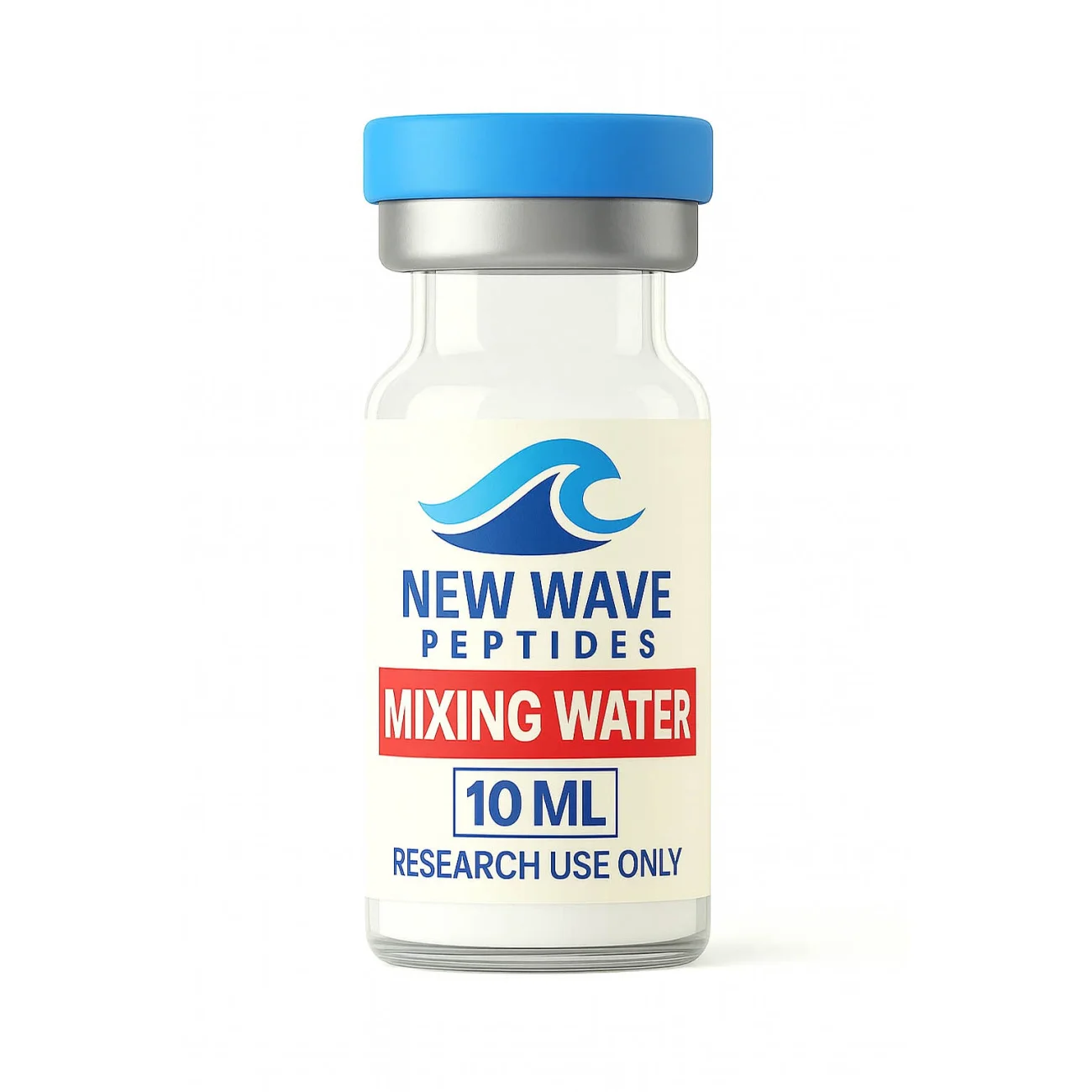
What Is Bacteriostatic Mixing Water?
Bacteriostatic water is sterile water with 0.9% benzyl alcohol added as a preservative. The benzyl alcohol suppresses the growth of most bacteria, so a vial can be entered more than once during a study without spoiling as quickly as plain sterile water. That single difference is why researchers keep it on the bench as their standard diluent for lyophilised peptides.
Most research peptides arrive as a freeze-dried powder, a format that keeps the compound stable through storage and transport. Before the powder can be measured accurately, it has to be returned to solution. Our 10ml vial gives you a clean, consistent liquid for that step, making it the natural partner for almost every peptide in the New Wave Peptide Shop range.
Why Researchers Choose Bacteriostatic Mixing Water Over Sterile Water
Sterile water for injection contains no preservative. Once its seal is punctured, it is meant for a single use and any leftover liquid should be thrown away. For a study that draws small volumes from the same reconstituted vial over several weeks, that is wasteful and raises the risk of contamination.
The preservative changes the picture:
- Multi-use format: with good aseptic technique, a vial can be accessed repeatedly, commonly for up to 28 days after first puncture.
- Consistency across a study: one diluent from start to finish removes a variable from your results.
- Wide compatibility: it suits most peptides, including BPC-157, TB-500, Ipamorelin and the CJC-1295 range.
A few compounds are exceptions. IGF-1 LR3, for example, is usually reconstituted in dilute acetic acid instead, which is why we also stock a 0.6% acetic acid solution.
Key Specifications
| Attribute | Detail |
|---|---|
| Volume | 10ml |
| Composition | Sterile water with 0.9% benzyl alcohol |
| Format | Sealed glass vial with rubber stopper |
| Intended use | Laboratory reconstitution of lyophilised research peptides |
| Storage | Room temperature unopened; 2–8°C after first use |
How to Use Bacteriostatic Mixing Water in the Lab
Good technique matters as much as the diluent. Wipe the stoppers of both the peptide vial and the water vial with an alcohol prep pad and let them air-dry. Draw your chosen volume into a sterile syringe, then let the liquid run slowly down the inside wall of the peptide vial rather than spraying it onto the powder. Swirl gently until the solution is clear. Never shake it, because agitation can damage fragile peptide chains.
The volume you add sets the concentration. Adding 2ml to a 10mg vial gives 5mg per ml, while adding 1ml gives 10mg per ml. Write the volume and date on the vial label so every later measurement in your study stays traceable.
Storage and Shelf Life of Bacteriostatic Mixing Water
Keep unopened vials at controlled room temperature, away from direct light. Once punctured, store the vial in a fridge at 2–8°C and use it within the window your lab protocol sets, commonly 28 days. Discard any vial that looks cloudy, discoloured or contains particles. Reconstituted peptides belong in the fridge too, as most break down faster in solution than as a dry powder.
Quality and Safety Notes
Benzyl alcohol is a well-characterised compound, and its full chemical profile is documented on PubChem. If you want background on why peptides are supplied as a powder in the first place, this overview of freeze-drying explains the process. Like everything on this site, this product is sold strictly for laboratory and research use and is not for human or veterinary use. UK guidance on research materials and medicines is published by the MHRA.
Order Bacteriostatic Mixing Water from New Wave Peptide Shop
Add a vial to every peptide order so your materials arrive together and your study can start on day one. Many researchers keep a spare in the fridge, since a single 10ml vial often covers several reconstitutions. Order today and keep your bench stocked with a reliable diluent from a UK supplier you can trust.

Reviews
There are no reviews yet.